The visit featured key engagements such as the Raisina Dialogue keynote and bilateral talks, focusing on strategic partnerships in AI development.

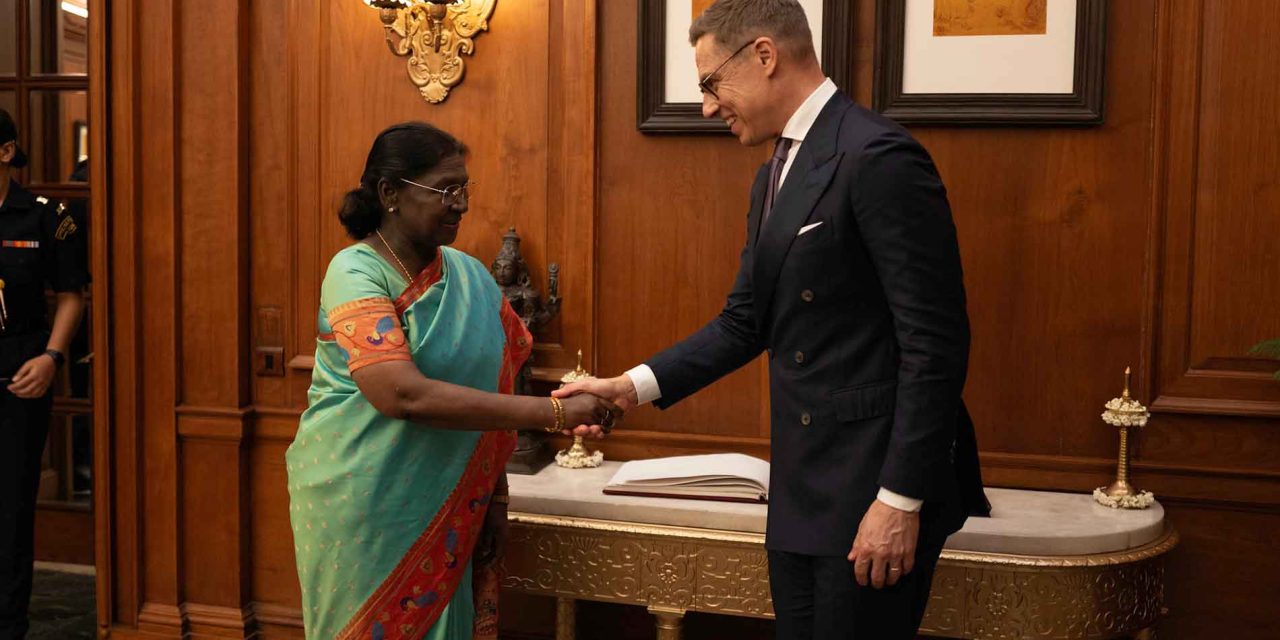
Finnish President Alexander Stubb made his first state visit to India from March 4–7 at the invitation of Prime Minister Narendra Modi accompanied by a high-level delegation.
The visit, which included stops in New Delhi and Mumbai and featured key engagements such as the Raisina Dialogue keynote and bilateral talks with Indian leaders, underscored strong India-Finland ties based on mutual respect, democracy and international law.
Roadsides in New Delhi were dotted with welcome signs featuring a familiar face: Finnish President Alexander Stubb.
The reception ceremonies were colorful, delightful and emotional.
We missed the action from afar! But we found President Alexander Stubb’s four-day India visit best described by two literal highlights: the sigining of a 2,500-word joint statement between India and Finland and the nearly 3,000-word keynote at the Raisina Dialogue.
Here’s the summary.
Arrived in India today for a state visit, just as the country celebrates Holi, the festival of spring and colours. What a wonderful way to begin the visit!
— Alexander Stubb (@alexstubb) March 4, 2026
Happy Holi! pic.twitter.com/A64ue9tXEz
Tack för det varma mottagandet till Indien, premiärminister @narendramodi.
— Alexander Stubb (@alexstubb) March 5, 2026
Indien är en viktig partner för Finland. Statsbesöket fördjupar vårt samarbete inom handel, ekonomi, vetenskap och innovation.
Det nyligen ingångna frihandelsavtalet mellan EU och Indien öppnar nya… pic.twitter.com/DnWuxydwXm
India and the EU Strengthen their strategic partnership
Both countries emphasized cooperation on safe AI development, sustainable development goals, climate action, trade expansion under the new India-EU Free Trade Agreement, digital transformation including advanced technologies like 5G/6G and AI startup collaboration.
The discussions also highlighted deepening ties with the European Union through trade agreements and security partnerships. Both sides reaffirmed their commitment to global peace efforts.
They focused on improving partnerships in weather science, land information systems, official statistics, movement and migration frameworks, education and skill development, audiovisual production, and multilateral cooperation.
The leaders ended by asking working groups to create practical plans for digitalization and sustainability in their partnership.
Need for rules-based global order amid rising conflicts
At the 11th Raisina Dialogue, President Stubb said that rising local conflicts in places like the Middle East, Sudan and Ukraine show the need to restore an international system based on rules and institutions.
This system helps prevent chaos and bad behavior. He disagreed with the idea that the rules-based world order is gone.
Instead, President Stubb supports practical ideas to improve global cooperation.
Using Finland’s thoughtful approach and India’s growing role from a Western viewpoint, this discussion looks at past and current problems while seeking future solutions.
Osana Intian valtiovierailun ohjelmaa osallistuin geopolitiikkaan ja talouteen keskittyvään Raisina Dialogue -konferenssiin.
— Alexander Stubb (@alexstubb) March 5, 2026
Kiitos kunniasta saada avata konferenssi tänään täällä New Delhissä. pic.twitter.com/6mKuJtTUyv
The global order is, according to Stubb, changing a lot, with countries in the Global South—especially India—becoming important leaders who can guide the world away from conflict toward working together through shared rules and institutions.